
Liquid insects?
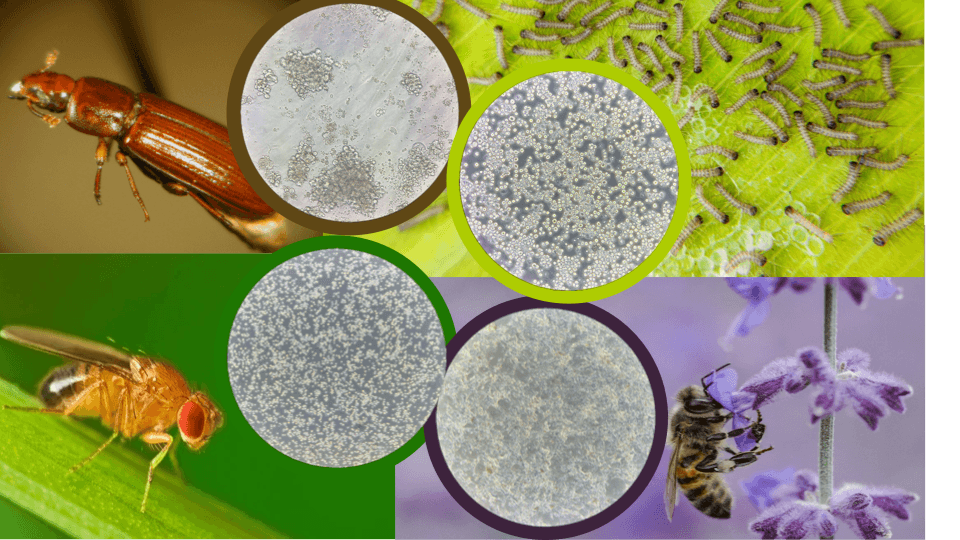
by Kitzia Molina
Meet ENSAFE’s insects -without wings, legs or escape attempts
Insects are everywhere -and we would be in serious trouble without them. They pollinate plants, recycle nutrients, and feed other animals in the food chain. But some also eat the crops we would rather keep for ourselves.
That creates a tricky question: how can we protect our crops while protecting the insects we depend on? Pesticides cannot read our “pest” and “pollinator” labels. Their selectivity depends on biological differences -and understanding those differences requires testing.
Experiments with whole insects are essential, but maintaining colonies and running tests takes time, work and large numbers of animals. Here in ENSAFE, we are exploring how insect cell cultures can help us investigate effects earlier and potentially reduce the number of whole insects needed.
Think of them as our “liquid insects”: living insect cells growing in nutrient-rich medium. No buzzing, no crawling -but plenty happening under the microscope.
Our laboratory cast includes:
TcA, from the red flour beetle (Tribolium castaneum). Representing the beetles, this familiar pest of stored grain products also has a useful second career as a research model. Its cells give us a window into beetle biology.
Sf9, from the fall armyworm (Spodoptera frugiperda). The caterpillars of this moth are hungry crop pests, particularly troublesome for maize farmers. Definitely an insect we would rather keep in the culture flask than in the field!
S2, from the fruit fly (Drosophila melanogaster). Our connection to one of biology’s best-studied model organisms. Decades of research provide a rich background for asking questions and interpreting what we see in these cells.
AmE-711, from the honey bee (Apis mellifera). The queen of our lab -at least in spirit! These bee-derived cells bring an important pollinator into our experiments. Honey bees belong to a much larger community of animal pollinators that supports crops accounting for around 35% of global crop production by volume. That contribution belongs to the whole pollinator team, rather than honey bees alone.
Of course, a flask of cells is not a miniature insect. It cannot reproduce the full journey of a pesticide through an animal: how it enters the body, reaches different tissues, is broken down and is eventually excreted. It also cannot tell us about effects on behaviour, reproduction or an entire colony.
What cell cultures offer is a closer look at the cellular story. We can investigate changes in gene activity, study effects on cell membranes and screen many conditions in parallel. Working with cells also helps us examine responses without mixing together signals from all the different organs of a whole insect.
By comparing these four cell lines, we hope to understand how cells from different insect species respond to peptide- and RNA-based plant protection products. They cannot represent all insect diversity, but they give us four useful perspectives on the same question: how can crop protection become more selective?
For now, I’m happy to introduce ENSAFE’s beautiful insect cultures. They may lack wings and antennae, but under the microscope, they have plenty of personality.