
Can AI help us design better and safer RNA-based pesticides?
By Lorenzo Favaro, PhD fellow
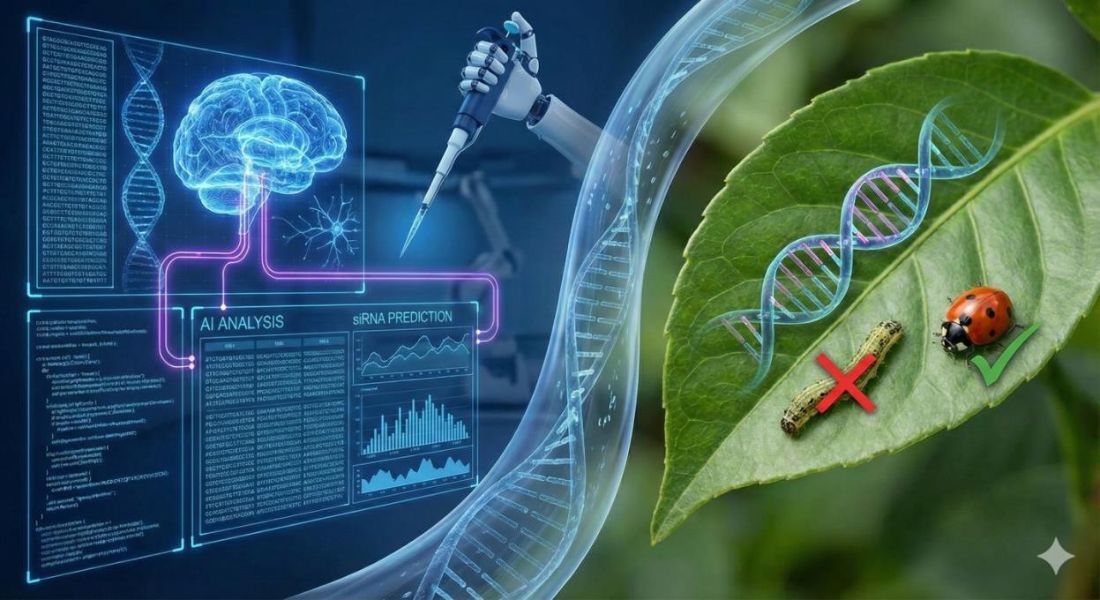
With the boom of artificial intelligence in recent years, the general public has come to know terminology such as large language models, of which tools like ChatGPT are the most famous representative, and machine learning (e.g. self-driving cars and autocorrect when typing on your smartphone). RNA-based pesticides (dsRNA/siRNA-based) promise to deliver species-specific pest control with minimal off-target impacts. In simpler terms, these new biopesticides are designed to target only harmful pest organisms and leave other beneficial insects unaffected.
How RNA pesticides work
This technology is called RNA interference. It works by delivering these RNAs to insect cells, where they bind to messenger RNAs (mRNAs), blocking their translation into proteins and damaging the organism’s system, possibly leading to its death. The problem arises when the short interfering RNA (siRNA), the 21-base-pairs long RNA used in these kinds of pesticides, encounters tens of thousands of different mRNAs inside the cell, each averaging 2000 base pairs. The RNA can exert its function even when binding is not perfect, creating thousands of possible target mRNAs within a single organism. To have biopesticides that work effectively and specifically against pest insects, we need to ensure these products target the right organisms, but assessing all possible interactions between each candidate siRNA and every insect every time in the wet lab would be costly and time-consuming.
Teaching AI to find the right targets
Modern sequencing technologies and AI come to our aid. By sequencing multiple organisms’ mRNAs, we don’t need to have all the insects in the lab every time we want to test our siRNA, because we already know all the mRNAs and their concentration in the organism cells. To train our machine learning model, we need to provide it with a large amount of data on how siRNAs interact with mRNAs inside cells. The starting point is always to perform experiments in the wet lab and gather information that we can teach to our AI model.
Once the model has learned how siRNA interacts with mRNA, we can ask it to make predictions about siRNA it has never seen, because at this point, it has extracted generalizable rules that govern these RNA interactions. It is very important to point out that the quality of the data is fundamental for this type of applications as the ML model can never outperform the data it has been trained on. A large part of the work, when dealing with AI, consists of cleaning and curating the dataset to give the model the best chances of making good, generalizable predictions.
My PhD aims to investigate the feasibility of developing such methods and the type of data required to enable trustworthy, reproducible predictions. At the state of the art, these systems cannot yet fully replace wet lab experiments. However, the hope is that the results of my research might help to significantly reduce the number of experiments needed and help identify cases where manual verification of interactions is required. Ultimately, this synergy between artificial intelligence and molecular biology represents a significant leap forward for sustainable agriculture. By using AI to sift through the noise of genetic data, we can accelerate the discovery of pesticides that are not only effective against crops' enemies but also safe for the ecosystem that surrounds them.